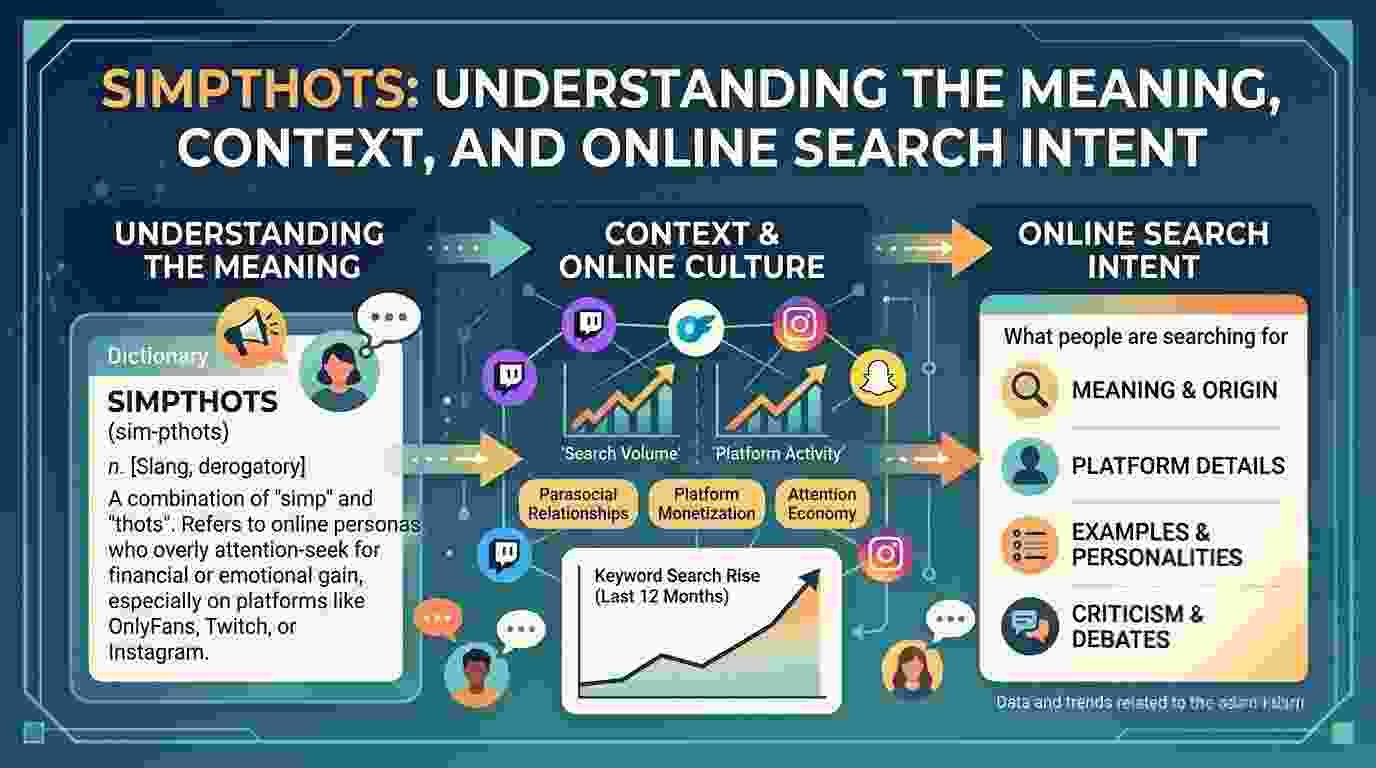
The internet is full of unusual keywords that develop through social media, forums, creator communities, and online conversations. Some terms become popular because they describe a particular type of content, while others gain attention because users repeatedly encounter them without knowing their meaning. The term simpthots is one such phrase that may appear in searches and community discussions.
Understanding a niche keyword requires more than looking at isolated search results. Internet terminology can change over time, and different communities may use the same phrase differently. A thoughtful approach considers context, search intent, community culture, and digital safety. This article provides a general explanation of the term and the factors users should consider when researching it online.
What Does Simpthots Mean?
The term simpthots appears to be an internet slang expression formed from two commonly used online words: “simp” and “thots.” In internet culture, “simp” is generally used to describe someone perceived as excessively attentive or devoted to another person, while “thot” is a derogatory slang term that has historically been used to describe women in a sexualized or insulting way.
When combined, the phrase can be used informally in online conversations about attraction, relationships, creator culture, or social-media behavior. Its exact meaning can vary depending on the community and the context in which it appears.
Because the expression can be derogatory, readers should be aware of the tone and implications before using it. Internet slang often carries meanings that are difficult to understand from the literal words alone.
Why Online Context Matters
A keyword may have one meaning in a meme or casual conversation and a different meaning in another online community. Looking at surrounding text is therefore important when trying to understand unfamiliar terminology.
Why People Search for Simpthots
Interest in simpthots may come from people encountering the term on social media, forums, memes, comment sections, or creator-related discussions. Users sometimes search unfamiliar slang simply because they want to understand a phrase they have seen repeatedly.
Search trends can also be influenced by online communities. When a term appears frequently in posts or comments, more users may begin searching for it. This creates a cycle in which curiosity increases visibility and visibility generates additional searches.
However, search popularity does not necessarily tell users what a term means in every context. A keyword can be used humorously, critically, descriptively, or offensively depending on who is using it.
Simp Culture and Online Communities
To understand the broader context of simpthots, it helps to recognize the role of “simp culture” in internet conversations. The word “simp” has become common in memes and social-media discussions, often referring to someone who appears overly eager to gain attention or affection from another person.
Online communities frequently turn relationship behavior into humorous labels. These terms can be used playfully between friends, but they can also become insulting when directed at specific individuals.
Social media has amplified this kind of language because short posts and viral memes encourage simple labels that can communicate an opinion quickly. As a result, slang terms can spread far beyond the communities where they originally became popular.
Language, Tone, and Digital Communication
Internet slang evolves quickly. A term that seems common today may become outdated or change meaning within a few years. Users should therefore avoid assuming that every person interprets simpthots in exactly the same way.
Tone is particularly important. Some people may encounter the phrase as part of a joke or meme, while others may view it as disrespectful. Words that describe people can have a stronger effect than users sometimes realize.
Using Online Slang Responsibly
A useful rule is to consider the audience before using slang. Casual language may be appropriate among friends who understand the context, but the same expression could be inappropriate in professional or unfamiliar settings.
It is also worth remembering that labels can reduce complicated relationships or personalities to a single stereotype. Clear, respectful language is usually better when discussing real people.
Digital Safety When Researching Online Terms
Searching for simpthots or any other trending phrase can lead users to many different websites. Not every search result is trustworthy. Some pages are created primarily to attract clicks, while others may contain misleading advertisements, suspicious links, or inaccurate information.
Users should be especially cautious with websites requesting passwords, payment details, or unnecessary personal information. Unexpected downloads should also be avoided unless the source is clearly legitimate.
Privacy is another consideration. Searching for a public term does not justify attempting to uncover someone’s private information. Responsible internet use means respecting personal boundaries and avoiding the distribution of sensitive material without permission.
When researching slang, reputable dictionaries, language references, established publications, and clearly contextualized discussions can be more useful than anonymous pages making unsupported claims.
FAQ About Simpthots
What does simpthots mean?
It is an internet slang expression combining “simp” with “thots,” generally appearing in informal conversations about attraction, relationships, or online culture.
Is simpthots a positive term?
Not necessarily. Because one component is commonly used as a derogatory term, the phrase can be insulting depending on context.
Where might people encounter it?
It may appear in social-media posts, memes, forums, comment sections, or other online discussions.
Does internet slang have fixed meanings?
No. Slang can change meaning depending on the community, speaker, audience, and time period.
Should the term be used casually?
Users should consider context and audience. If the expression could be interpreted as insulting, more neutral language may be preferable.
Conclusion
The term simpthots illustrates how quickly internet slang can develop and spread across social media and online communities. Its meaning is connected to broader internet expressions involving attraction, relationships, attention, and social behavior, but its interpretation can vary significantly depending on context.
Understanding online terminology requires more than memorizing definitions. Readers should consider tone, audience, community culture, and the potential impact of language on other people. They should also approach search results carefully, protect personal information, and avoid suspicious websites.
As internet language continues to evolve, responsible communication remains important. Knowing what a term means is useful, but knowing when and how to use it is equally valuable.